

Description
Early Eocene
Green River Formation
Kemmerer
Wyoming, USA.
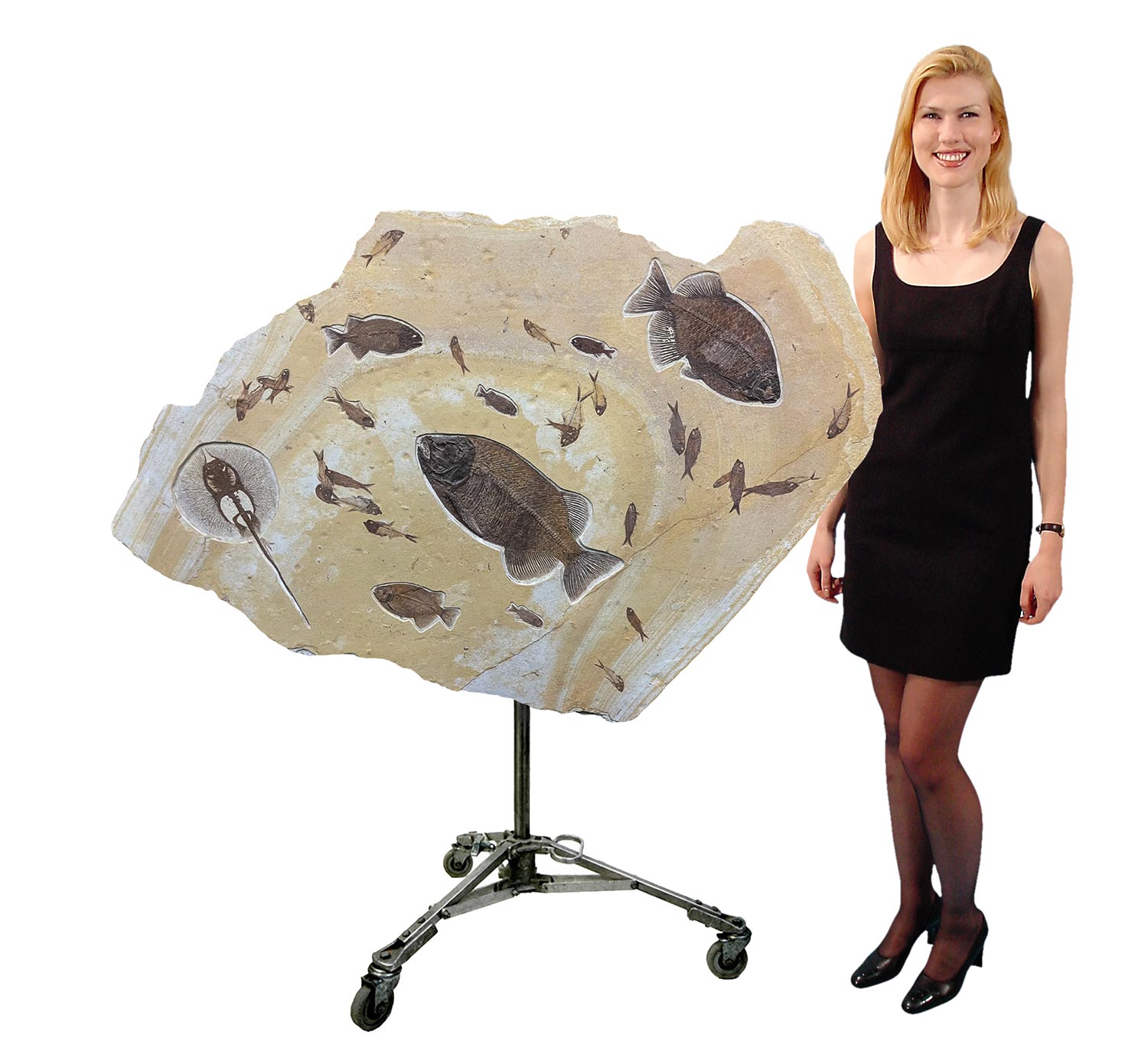
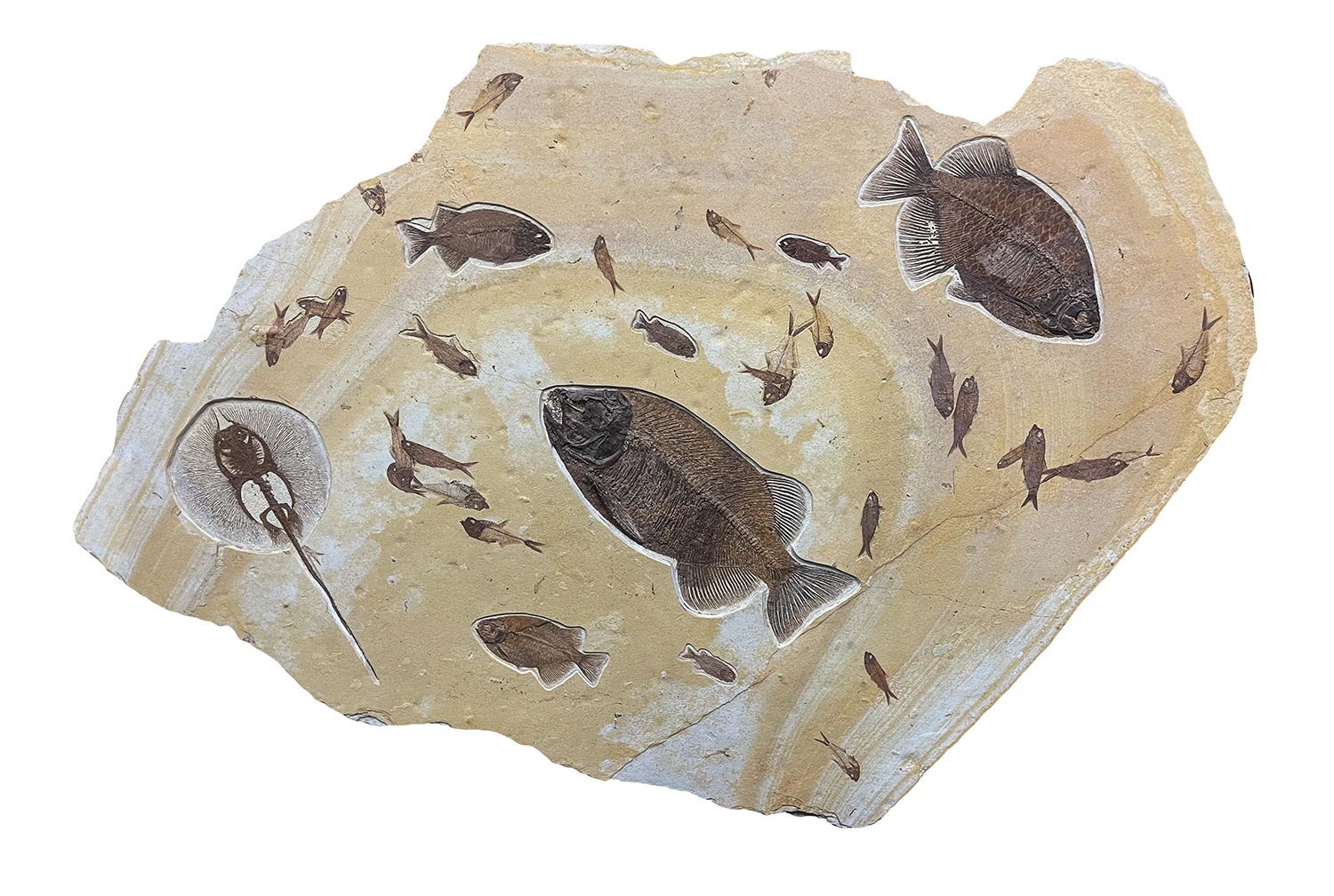
Enormous 61 inch slab with 33 fish – 1 Heliobatis radians stingray, 5 Phareodus encaustus and 27 Knightia alta. Easily the most beautiful Green River specimen we have ever seen. You KNOW you want this on your wall. Inquire about shipping/delivery options.
See: Wikipedia – Green River Formation
Bonus! Here is the famous monograph by Lance Grande on the fish of the Green River Formation in PDF form FREE: Grande, L. (1984). Paleontology of the Green River Formation, with a review of the fish fauna (Vol. 63, pp. 1-333). Laramie, Wyoming: Geological Survey of Wyoming.
The fish fauna of the Green River Formation is one of the most spectacular freshwater fish assemblages in the fossil record. The formation, exposed mainly in Wyoming, Utah, and Colorado, records a system of large Eocene lakes that existed roughly 53–48 million years ago. It is especially famous because fine-grained lake sediments could preserve entire fish skeletons, sometimes in enormous mass-death assemblages.
The Green River Formation wasn’t deposited in one enormous lake. It represents several related intermontane lake systems, especially:
Fossil Lake — southwestern Wyoming
Lake Gosiute — mainly southwestern Wyoming
Lake Uinta — northeastern Utah and surrounding areas
Their fish communities weren’t identical. For example, Diplomystus and Knightia are particularly characteristic of Fossil Lake, while Lake Gosiute had distinctive catfish and sucker fishes.
Knightia — the most famous fossil fish in the world
Knightia was a small herring relative, generally around 10–15 cm long, although K. eocaena could reach roughly 25 cm. It had a deepish, laterally compressed body and heavy scales. It was probably primarily a plankton/invertebrate feeder, consuming things such as algae, diatoms, insects, ostracods, and occasionally smaller animals. Most importantly, Knightia appears to have been a schooling fish. Some Green River beds contain enormous concentrations of Knightia like the plate displayed here, representing mass mortalities. Some ancient schools may have contained millions of fish. That abundance made Knightia the ecological equivalent of a huge forage-fish population and that had consequences: practically every sizeable predator in the lake could exploit it.
Phareodus — the big, toothy predator
Phareodus encaustus was an important fish predator. It had a relatively elongated body, large jaws, conspicuous teeth and fins positioned toward the rear of the body, Its anatomy strongly indicates active fish predation. Fossils of Phareodus have also been associated with Knightia prey. It occupied a somewhat different ecological role from Mioplosus, showing that the Green River lakes had multiple kinds of piscivores competing for fish prey.
Heliobatis — the stingray
Heliobatis was a member of Myliobatiformes, the group containing modern stingrays, butterfly rays, eagle rays, and their relatives. Despite living in freshwater, it was unmistakably a stingray. It had:
a broad, flattened pectoral disc
a long, slender tail
a flexible cartilaginous skeleton
small pelvic fins
a pointed snout
and a venomous tail spine
Modern stingrays are overwhelmingly associated with marine environments, although several lineages have independently adapted to freshwater. Heliobatis was one of these freshwater forms. Its flattened body and underside-oriented mouth indicate that it was primarily a bottom-feeder. It probably searched through the lake sediment for small animals such as:
worms
crustaceans
mollusks
insect larvae
small fish
Modern stingrays use their flattened bodies and specialized electroreceptive systems to locate prey buried in sediment. We can’t demonstrate exactly how Heliobatis behaved, but its anatomy suggests a broadly similar benthic feeding lifestyle. Like modern stingrays, Heliobatis possessed a serrated, barbed spine associated with venom glands. The spine was primarily a defensive weapon, rather than something the ray used to kill prey. That means that an Eocene Heliobatis swimming around Fossil Lake was potentially dangerous to predators that tried to attack it.