

Description
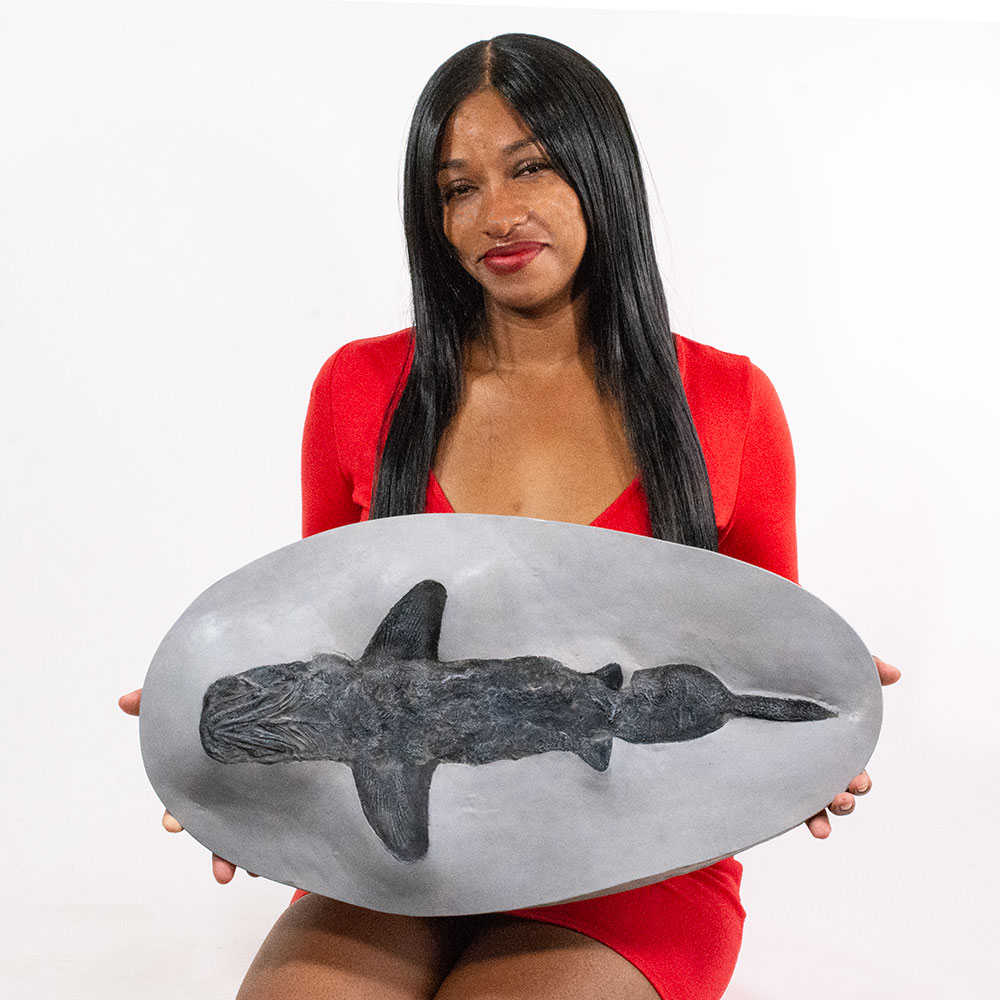
Cladoselache fyleri CAST
Devonian
Cleveland Shale
Cleveland, OH, USA
500mm (19.5 inch) CAST of one of the earliest known sharks. 590mm (23 inch) total length with wire mount on back suitable for hanging.
Cladoselache was an early shark-like fish that lived during the Late Devonian, about 380–370 million years ago. It is one of the best-known early members of the shark lineage and is especially valuable because some fossils preserve remarkably detailed impressions of its soft tissues.
Cladoselache was a relatively streamlined predator, reaching roughly 1–2 meters (3–6.5 feet) long. It already possessed many features associated with sharks:
A cartilaginous skeleton
Multiple rows of teeth
Paired fins
A heterocercal-type tail
A streamlined body
A powerful caudal fin for swimming
Cladoselache had a long, slender body and relatively simple fins. Its body shape suggests that it was an active swimmer in open water.Its large tail provided much of its propulsion, while the pectoral and pelvic fins helped with stability and maneuvering.
Interestingly, its body lacked some of the elaborate structures seen in modern sharks. For example, it appears to have had relatively weakly developed fin spines and relatively simple fin arrangements.
Cladoselache had small teeth with multiple cusps rather than the large, blade-like teeth of famous modern sharks such as great whites. The teeth were probably suited for grabbing slippery prey rather than slicing through large chunks of flesh. Fossils provide evidence that it ate animals such as small fish and cephalopods.
One of the most interesting features of Cladoselache is its mouth and jaw structure. Unlike modern sharks, its jaws appear to have been relatively short and positioned toward the front of the head. It may have captured prey by rapidly opening its jaws and using suction and forward movement. Some fossils even preserve prey remains inside the body, providing direct evidence of what it ate.
The big question for Cladoselache boils down to: is it a “primitive shark”?
Yes—but with an important qualification. Cladoselache is generally considered a stem shark, meaning it belongs on the evolutionary branch leading toward modern sharks and rays but isn’t simply an unchanged early version of a modern shark. The evolutionary tree is roughly:
Early jawed vertebrates → early cartilaginous fishes → stem sharks such as Cladoselache → later sharks and rays
Modern sharks have evolved enormously since the Devonian.