

Description
Houia yueya Lamsdell, Xue & Selden, 2013
Early Devonian
Xishancun Formation
Shangxishan Reservoir near Qujing city, Yunnan, China
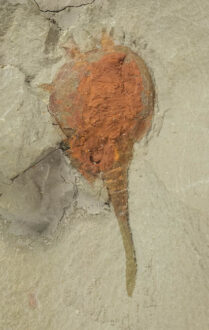
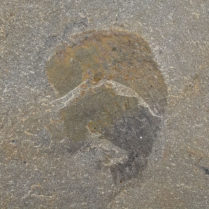
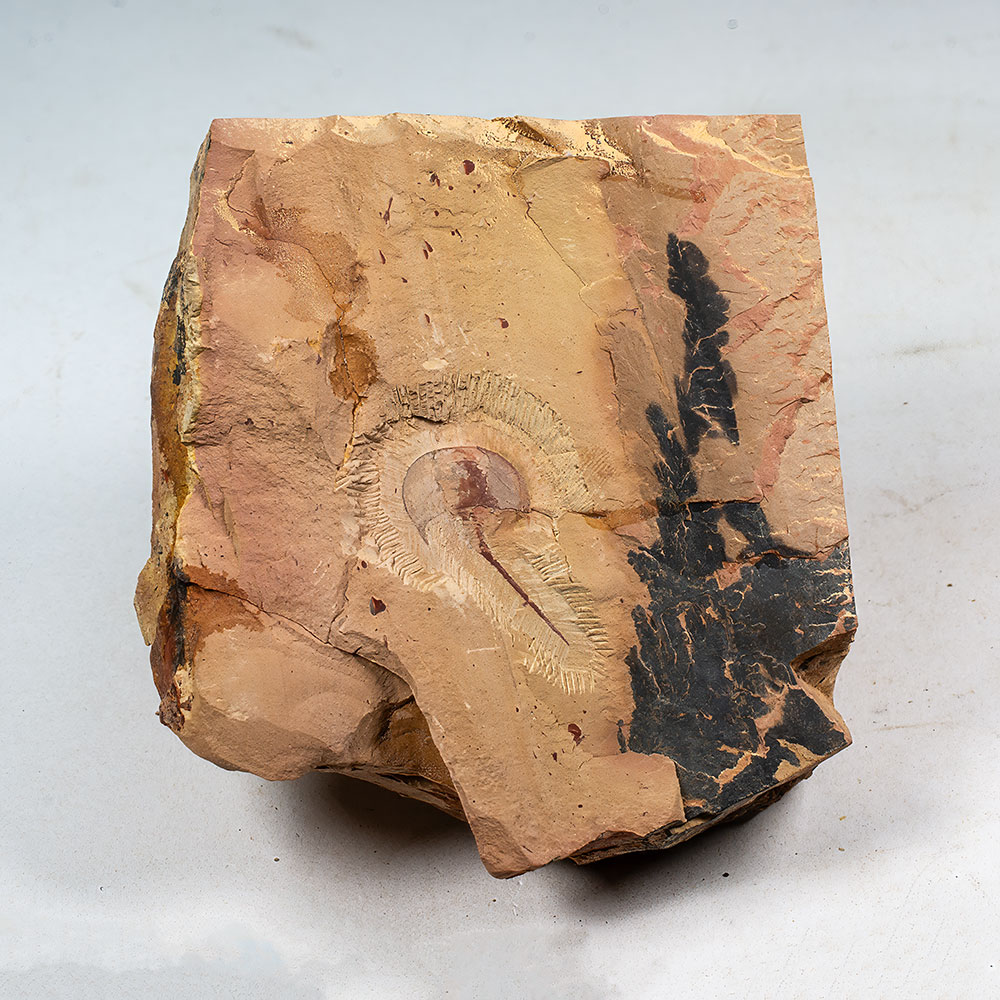
Extremely rare 28mm early horseshoe crab on 95mm slab. First we have ever seen.
Houia was a strange Early Devonian chelicerate from China, roughly 410–400 million years ago. It is often described as a very early horseshoe-crab relative, but there is an important twist: its exact position on the chelicerate family tree is still debated.
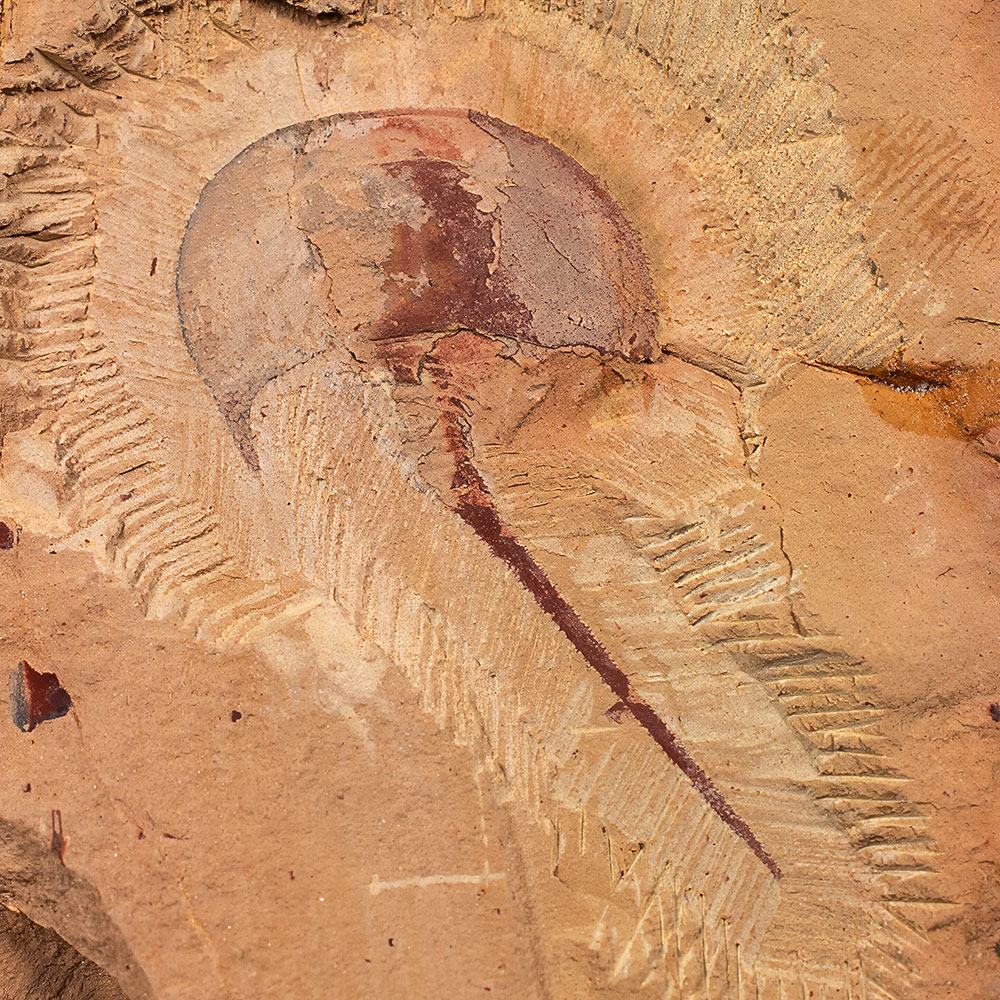
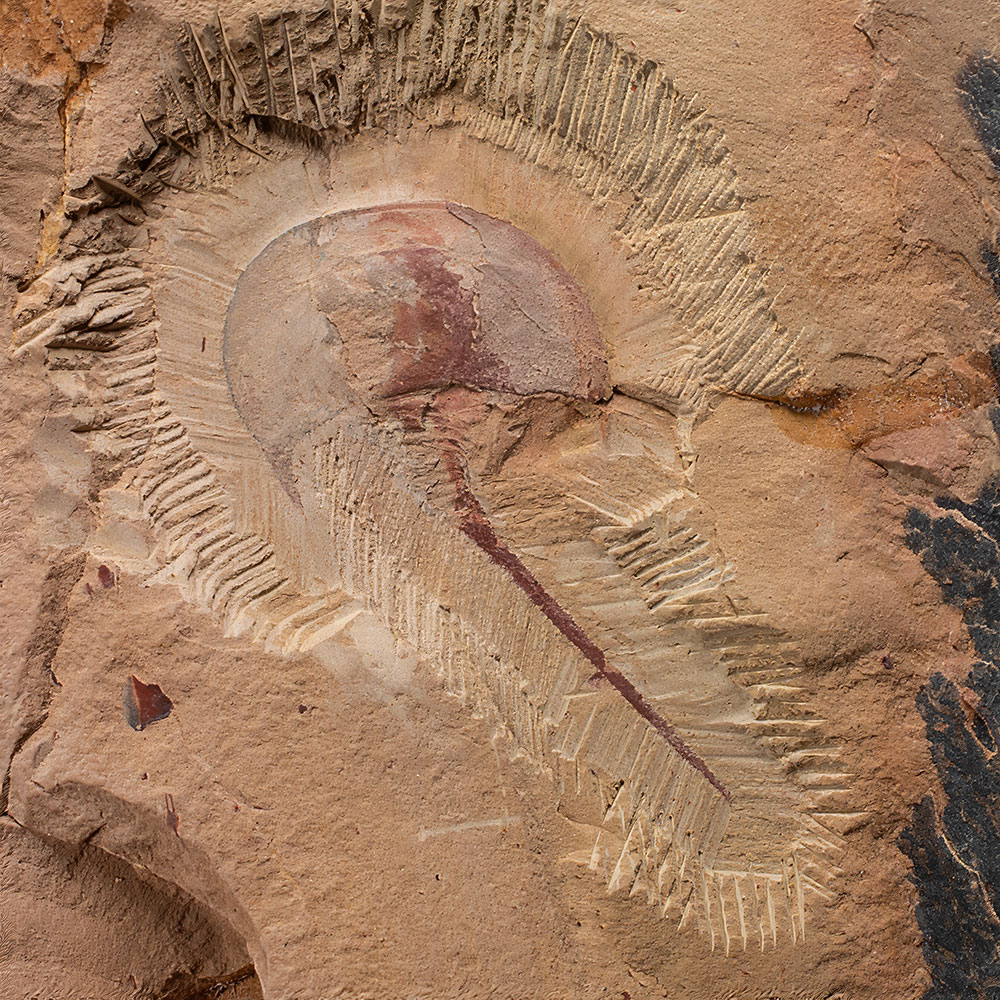
The carapace is the feature that initially made scientists think they were looking at a horseshoe crab, but Houia wasn’t simply a normal horseshoe crab, but this is where it gets really interesting. When Houia was first described in 2013, it was placed in the horseshoe-crab genus Kasibelinurus. Later specimens revealed its underside much more clearly. Those specimens showed that Houia possessed a large metastoma, a structure particularly characteristic of other chelicerates such as eurypterids and chasmataspidids.
Consequently, in 2015 it was removed from Kasibelinurus and given its own genus, Houia. The original 2015 analysis interpreted Houia as a basal euchelicerate, branching off before the major lineages leading to eurypterids, arachnids, and chasmataspidids diversified.
Scientists sometimes describe Houia as a possible “link” between horseshoe crabs and eurypterids because it possesses characteristics associated with both, but it wasn’t necessarily the direct ancestor of either group. Houia may represent one of the early experiments in chelicerate evolution, close to the point where the major lineages were diverging.
Later work has questioned the original interpretation of Houia. One study noted that its large ventral plate resembles the buckler of chasmataspidids and that its body has nine opisthosomal segments, raising the possibility that Houia could actually be a chasmataspidid rather than a basal horseshoe-crab relative, so its precise evolutionary position isn’t completely settled.
See: Wikipedia – Houia